Questions to Ask After Meeting Someone

What Questions Should You Ask After Meeting Someone?
Useful questions to ask after meeting someone build on a detail they shared and invite them to say more. Start with one relevant follow-up, such as “How did that presentation you mentioned go?” or “What first drew you to that hobby?”
The best starting point is usually something unfinished: an event they were preparing for, a recommendation they wanted to try, or a project that interested them. Asking for an update gives the conversation continuity without requiring a personal revelation. It also leaves room for an answer you did not expect.
If someone who recently moved says they miss their old neighborhood, “What do you miss most about it?” makes more sense than jumping to their favorite holiday destination. You do not need a remarkable question. Notice which part of their answer seems to matter to them, and begin there.
Choose Follow-Up Questions That Fit the Connection
Choose follow-ups that suit the setting and the relationship you actually have. A friendly conversation, a possible date, and a professional introduction can begin with the same shared interest but lead in different directions.

Picture it: two neighbors, Maya and Ellis, meet beside the refreshment table at a neighborhood event. In this hypothetical scenario, Ellis mentions starting a beginner pottery class. Maya has been looking for something to do away from a computer, so they talk about whether beginners need any equipment. Before leaving, they exchange numbers and agree it would be nice to stay in touch.
Maya now has a useful opening: “How did your next pottery class go?” She does not yet know whether Ellis wants a new friend or simply enjoyed that evening’s conversation. An update lets them find out whether they enjoy talking again without making the exchange carry too much weight.
Context still matters. A professional acquaintance who mentioned a course might welcome “Have you had a chance to use anything from the course at work?” After a conversation about a possible date, a clear invitation may be more useful than another general question. Neither setting gives you permission to assume closeness that has not developed.
What Are 10 Questions to Get to Know Someone?
These ten questions invite updates, preferences, and small stories without assuming you already know someone well. Choose one that connects to your previous conversation.
- “How did that event go?”
- “What have you enjoyed about your new routine?”
- “Did you get a chance to try that recommendation?”
- “What got you interested in that?”
- “Which part do you enjoy most?”
- “What would you suggest to someone trying it for the first time?”
- “What surprised you about it?”
- “What has been the highlight so far?”
- “What would you like to try next?”
- “What are you looking forward to about that?”
These questions do different jobs. Asking what surprised someone invites a story; asking what they would recommend gives them a chance to share knowledge. “What’s been the highlight?” suits an experience they have described positively. If they sound disappointed, “How has it been?” leaves more room for an honest answer.
For other starting points, browse these questions to ask to get to know someone. Treat a question bank as preparation, then put it aside when the conversation begins. You are choosing an opening, not collecting answers to a checklist.
Turn Their Answer Into a Natural Conversation
A conversation needs responses as well as questions. Acknowledge what someone means and contribute something relevant before reaching for another prompt.
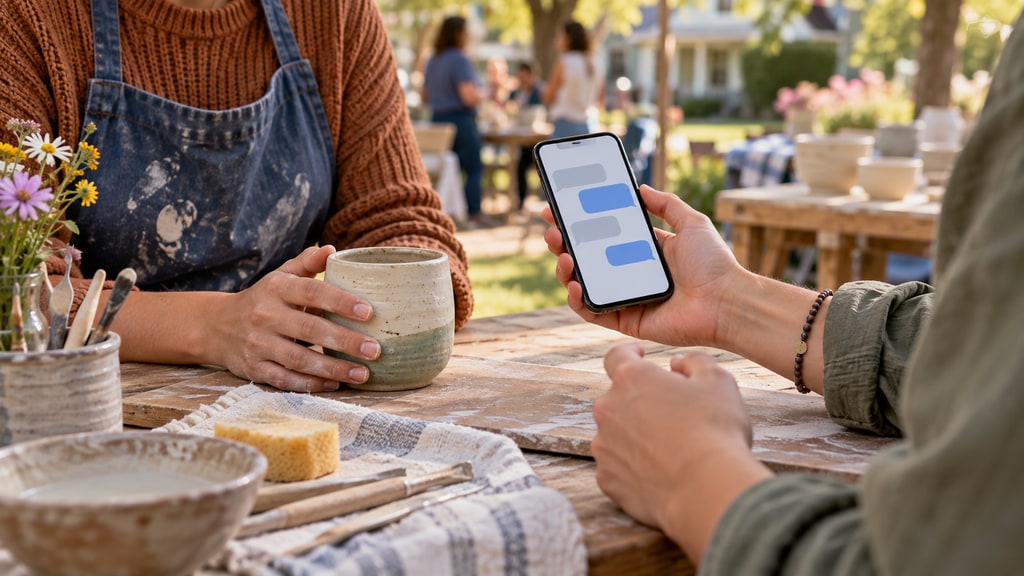
A week after the neighborhood event, Maya sends Ellis a message about the next class. Ellis replies, “I liked it, but the wheel was frustrating.” Maya asks what made it tricky. “The clay kept collapsing,” Ellis says, “but I loved being away from screens.”
The topic has shifted. The broken pot was part of the experience, but the time away from screens was its reward. Maya responds, “The break from screens was what appealed to me when you first mentioned the class. It sounds like you got that, at least.” This connects Ellis’s answer with their original conversation and gives Maya a place in the exchange.
She could offer pottery advice, but Ellis has not asked for it. Another technical question might overlook the point Ellis just made. My editorial recommendation is to respond to the meaning before searching for another prompt: it gives the other person evidence that their answer registered. Keep that response tentative enough for them to correct your interpretation.
In person, a pause can also do useful work. Someone may be deciding how to describe an experience rather than waiting for you to rescue the conversation. Let them finish. If they ask about you, answer with enough detail to offer something they can follow up on, too.
What Are 10 Deep Questions?
Deep questions explore values, meaning, and aspirations. They become useful when both people want that kind of conversation; a private or painful answer is not the measure of success.
- “What makes that important to you?”
- “When do you feel most like yourself?”
- “What does a satisfying day look like for you?”
- “Has that experience changed your perspective?”
- “What are you learning about yourself lately?”
- “What would you like to make more room for?”
- “What helps you feel understood?”
- “What do you appreciate most in a friendship?”
- “How has your idea of success changed?”
- “What would you like your everyday life to feel like?”
Give these questions a reason to be there. A discussion about a changing work schedule might lead naturally to what a satisfying day looks like. Asking about someone’s idea of success immediately after exchanging names can feel like assigning an essay.
There is also room for an ordinary answer. Someone might want more sleep or a free Saturday. Accept what they offer without treating it as a shallow response that needs excavation. Familiarity can grow through everyday preferences as well as major life experiences.
Recognize When to Stay Light or Change Direction
When someone hesitates, answers minimally, or changes the subject, give them an easy way to move on. Those behaviors do not prove discomfort or disinterest, but you do not need proof before easing the pressure.
In the hypothetical exchange, Ellis mentions wanting more evenings like the pottery class. Maya asks, “What would you like to make more room for?” Ellis replies, “Not sure. It’s a bit of a long story.” Maya had intended a thoughtful question, but the response suggests this is not the moment to pursue it.
“We can leave that there,” she replies. “Did anything survive the wheel this week?” Ellis tells her about a lopsided bowl that made it onto the drying shelf. The conversation continues because Maya accepts the limit instead of asking Ellis to justify it. She learns that sharing an interest does not automatically mean wanting to discuss everything behind it.
Health, finances, trauma, and past relationships deserve particular care. If someone brings up a breakup, for instance, ask whether they want to talk before requesting details. These questions to ask a friend after a breakup offer a more focused starting point when that conversation is welcome. With a new acquaintance, let their willingness to share set the scope; questions suited to a close friend may be too personal.
Questions to Ask After Meeting Someone Over Text
Send a short message that identifies you, recalls where you met, and asks one easy follow-up. Use contact details they shared for staying in touch, and keep the opening proportionate to your previous exchange.
Maya’s first message could read: “Hi Ellis, it’s Maya from the neighborhood event. It was nice chatting with you. How did your second pottery class go?” The reminder makes the message easy to place, and the question provides a specific starting point.
If you cannot recall a detail, be honest: “It was nice meeting you at the neighborhood event. What did you think of it?” Do not invent a memory to sound attentive. If your memory is incomplete, say so: “I think you mentioned starting a course. How is that going?”
A delayed reply cannot tell you whether someone is busy, distracted, or uninterested. There is no universally correct waiting period. Give them time, and avoid sending increasingly personal prompts to provoke a response. If the exchange repeatedly depends on you restarting it, you can let it rest without demanding an explanation.
Text also leaves tone uncertain. A brief “It was fine” may simply be all someone has to say about that subject. You do not have to decode it or ask whether you did something wrong. Respond to what is there, and allow the exchange to end if it has reached a natural stopping point.
Common Follow-Up Mistakes and Better Alternatives
Awkward follow-ups often ask too much at once or make the other person manage an avoidable misunderstanding. A small repair is usually enough.
- Stacking questions: “How did you start, why that field, and what’s next?” creates several competing requests. Start with the part you actually want to understand, then let the answer determine whether another question is needed.
- Requesting information you already have: Instead of repeating “What do you do?”, ask about the project or responsibility they mentioned.
- Making your mistake their problem: If you misremember, correct yourself briefly: “Sorry, you said teaching, not nursing—how are you finding the new role?” A lengthy apology can derail the exchange.
- Turning curiosity into a challenge: “Why would you choose that?” can sound like a demand to defend a preference. “What appealed to you about it?” asks about the same decision without putting them on trial.
Another mistake is treating every answer as a cue for your own longer story. Sharing is welcome when it creates common ground. It becomes a takeover when their unfinished experience disappears beneath yours. If you catch yourself doing that, return the floor: “I interrupted—what happened next?”
Use Shared Interests to Suggest Another Meeting
A shared interest can support a specific, optional invitation. Make the purpose clear enough that the other person knows whether you mean a friendly outing, a date, or a professional follow-up.
After Ellis describes the surviving bowl, Maya mentions that she would enjoy seeing handmade ceramics. “Would you like to browse the local craft market together on Saturday?” she asks. Ellis replies, “I can’t this weekend, and I don’t want to commit to plans right now.”
Maya answers, “No problem—I enjoyed catching up. Hope the bowl makes it through firing.” She does not bargain for another date or interpret the earlier conversation as a promise. They have had a pleasant exchange, and Ellis has been able to decline a meeting without defending the decision.
That is a worthwhile outcome. Maya has reconnected and learned the limits of the connection as it stands. If someone accepts an invitation, settle the practical details. If they decline without suggesting an alternative, leave the next move available to them.
As a friendship develops, remembering preferences can help with more specific occasions. If a new friend invites you to a birthday celebration, this guide to asking someone what they want for their birthday addresses that separate conversation. Enjoying a hobby does not necessarily mean wanting equipment for it; a direct question can be more considerate than a guess.
Conclusion: Let the Last Answer Shape the Next Question
Before following up, remember one detail and decide what you are sincerely curious about. During the exchange, notice when the answer changes the subject, supplies an opening, or closes a door. Your prepared question has done its job once the conversation can proceed without it.
Maya and Ellis’s hypothetical exchange began with a pottery class, reached a personal boundary, and ended with a declined invitation that neither person had to turn into a confrontation. The practical takeaway is that a good follow-up gives someone a comfortable way to continue and an equally comfortable way to stop. Judge the conversation by the room you both had to participate, not by how much information you obtained.
Source: https://whattogetmy.com/questions-ask-after-meeting-someone/