Virtual Game Night for Couples: Make It a Real Date

How to Turn a Virtual Game Night Into an Intentional Date
Treat a virtual game night for couples as a planned date: agree on the mood, set a start and approximate end time, and prepare devices, drinks, snacks, and lighting beforehand. Silence unrelated notifications, then follow a simple rhythm—arrive, warm up, play, pause to talk, and close together.
The important choice is not simply what to play, but what kind of evening you want. Cooperative play suits a tired week when companionship matters more than winning; light competition can revive a call that has become predictable. A deliberate pause keeps the app from swallowing the date. At the end, share the funniest moment, name something you appreciated, or choose the next activity so the connection does not end with a disconnected screen.
Choose Online Couple Games That Match the Mood
Good starting choices include Codenames Online for quick wordplay, Board Game Arena for turn-based tabletop games, Skribbl.io for casual drawing, GeoGuessr for shared exploration, and mobile games such as Plato for short rounds. Availability, pricing, advertisements, and device support can change, so check the current terms before planning the date.
| Game or platform | Device and cost | Typical commitment | Best fit |
| Codenames Online | Browser; commonly available without a purchase | Short rounds | Wordplay and easy conversation, especially if another couple joins |
| Board Game Arena | Browser and supported mobile devices; free and paid access vary by game | Short fillers to longer strategy sessions | Couples who enjoy tabletop strategy and do not mind learning rules |
| Skribbl.io | Browser; commonly free | Quick drawing rounds | Silly, low-pressure evenings; it works better with extra friends than as a strict two-player contest |
| GeoGuessr | Browser or supported app; access and paid features vary | One location or a longer challenge | Curious couples who like travel talk and solving clues together |
| Plato | Phone app; free access with optional purchases or advertising | Several brief matches | Low-setup dates built around familiar card and arcade-style games |
| Keep Talking and Nobody Explodes | One player runs the purchased game while the other uses the manual; supported devices vary | Timed rounds | Energetic teamwork, provided neither partner dislikes time pressure |
| Chess.com or Lichess | Browser and phone; free play is available, with optional paid features on some services | A timed game can be brief or substantial | Competitive couples with reasonably matched skill or agreed handicaps |
For more possibilities, browse these online games for couples to play together. Check player count carefully: some party games become enjoyable only after inviting friends. Also confirm device compatibility, regional availability, accounts, privacy settings, learning curve, and whether either person dislikes timers or direct competition. Free online games for long-distance couples are often sufficient; paying makes sense when both partners expect to use the extra content or smoother hosting regularly.
Do not confuse a long menu with a good match. One familiar title can be more inviting than an unfamiliar platform with dozens of modes. If you are comparing formats rather than individual games, this guide to DIY and virtual party games can help clarify how much setup and screen structure you actually want.
Set the Atmosphere Across Two Rooms
A shared sensory cue can make separate rooms feel connected. Pick one or two details rather than staging a production: warm lamps, the same playlist, matching snacks, or an agreed dress level. Position the camera near the game screen if possible, but leave enough light on each face for reactions to be visible.
Start before opening the game. Show each other the snack choice, pour a drink, and spend a few minutes arriving mentally. During phone-based games for long-distance couples, a natural stopping point after a round is a better invitation to talk than an alarm interrupting play. In my view, atmosphere deserves more attention than elaborate rules: a simple game in a thoughtfully prepared room feels more like a date than an impressive game launched during a distracted call.
Pace the Night With Rounds and Conversation Breaks
A 75-minute plan is a useful option, not a test: perhaps five minutes to settle in, ten for a warm-up, twenty for the main game, a conversation break, another set of rounds, and an unhurried goodbye. For a phone date, favor games with clean stopping points when conversation is the priority.

Different couples need different rhythms. Two competitive strategists may want one uninterrupted match followed by a debrief over dessert. A talkative pair might play three fast word-game rounds, wander into a story sparked by an answer, and never return to the scoreboard. Partners arriving exhausted after work may be happier with a single cooperative puzzle and an early close. The schedule serves the mood; it should not police it.
During a pause, ask about a surprising choice or mention a moment you enjoyed instead of analyzing every error. If the technology has already consumed twenty minutes, abandon the ambitious plan. The useful measure is not how many rounds were completed but whether both people remained present.
Give the Game Playful Stakes Without Creating Pressure
Use stakes that are light, reversible, and mutually agreed. The winner might choose the next playlist or date theme; a shared reward could be planning the same dessert for the following call.
Avoid money, humiliation, punishment, or unwanted intimacy. Romantic rewards belong in the game only when both partners explicitly want them, and either person can revise a rule without having to defend the decision. A reset phrase can stop teasing immediately when the mood shifts. Competition can add spark, but a technically fair rule is still a poor date choice if it makes one partner tense.
Use Couple Question Games to Deepen the Date
Couple question games work best when prompts progress from playful to more personal and either partner may pass. The purpose is curiosity, not extracting disclosures.
Begin with something easy: “What harmless habit would make you a terrible spy?” Later, try “What part of your week do you wish I understood better?” or “What small ritual would you like us to repeat?” Adapt 20 Questions by choosing a category, answering one prompt each, and allowing one natural follow-up before resuming play. That limit prevents the evening from taking on the tone of an interview.
For intimate or spicy prompts, agree on acceptable territory beforehand and use an uncomplicated stop signal. Hesitation is enough reason to change the question. A surprising answer can be left for another conversation rather than resolved before the next round.
Plan a Virtual Game Night for Couples on Phones
For a phone-only date, choose a cross-platform game with simple invitations and rounds that pause cleanly. Confirm iPhone and Android support, regional availability, account requirements, voice chat, expected data use, and whether switching between the game and video will interrupt either app.
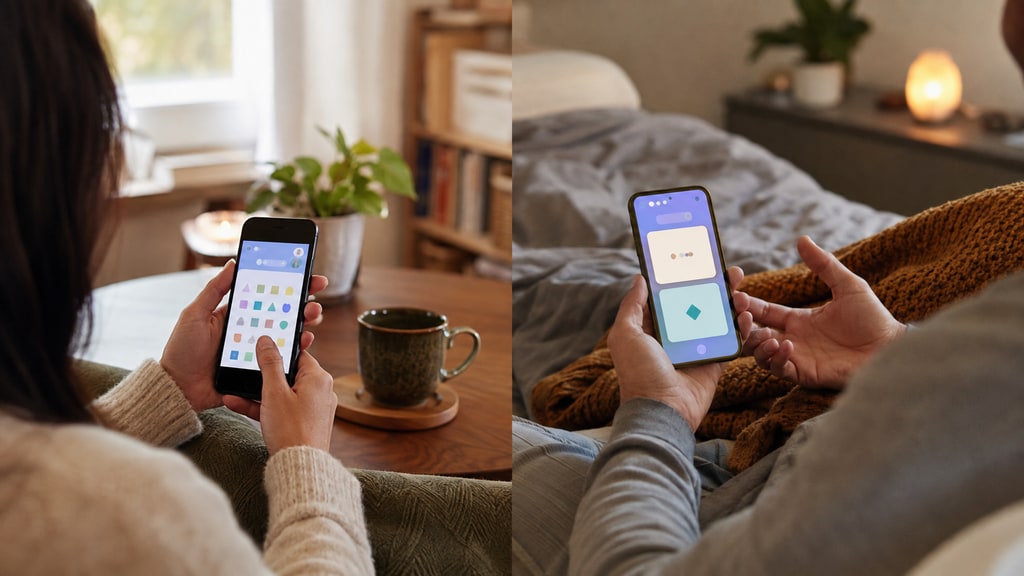
If both people have only one phone, audio calling while playing may be more stable than trying to maintain video. A browser question game suits a conversation-led night; live multiplayer supplies friendly stakes; an asynchronous app can bridge conflicting schedules, although it feels less like a real-time date. Charge the devices, keep the invitation link handy, and decide on a fallback before starting. Collaborative storytelling, twenty questions, or a photo scavenger hunt can rescue the evening without another download.
Test the invitation and audio before date time, especially when one person has an older device or limited storage. Many avoidable problems come from unclear instructions, incompatible apps, or trying to learn complicated controls while talking. A review of common virtual game mistakes and practical fixes can help you identify that friction in advance.
What Is the 2-2-2 Rule for Couples?
The 2-2-2 rule is a popular scheduling idea: a date every two weeks, a getaway every two months, and a longer trip every two years. It is not an established relationship standard, and its origin is often repeated without reliable attribution.
A long-distance couple can borrow the underlying principle—protect recurring time together—without treating the numbers as a prescription. A virtual date may fill the regular-date slot, but it need not replace every in-person experience. Versions of the related 7-7-7 variation commonly call for a date every seven days, an overnight stay or getaway every seven weeks, and a longer vacation or trip every seven months. Descriptions vary, so neither framework should be treated as an authoritative formula. Adapt the intervals around time zones, caregiving, budgets, leave from work, and the frequency each partner actually enjoys. A boundary around protected couple time may also help when other obligations intrude; this account of a date-night firewall and family stress offers a more specific example of that principle.
A Repeatable Long-Distance Date Scenario
Consider an explicitly hypothetical couple, Mina and Alex, living in different cities. Their Sunday calls once felt comforting, but lately each has been folding laundry, reading notifications, and asking some version of “How was your week?” Silence is not the problem; the sense that neither person has truly arrived is.
For the next Sunday, they change only a few things. On Friday they agree that they want a light, cooperative evening rather than a fierce contest. They choose one familiar mobile game, verify the invitation, and each buys the same kind of salty snack. When the call begins, the game stays closed for the first few minutes. They show each other their rooms and laugh because Alex has poured the snack into a formal serving bowl while Mina is eating from the bag.
The first round goes badly after a notification covers Mina’s controls. Instead of spending the date repairing settings, they silence alerts and restart. After two rounds, Alex asks why Mina made an unexpected choice in the game; the answer becomes a story about a difficult meeting that had not surfaced during their routine check-in. They skip the planned final round because that conversation matters more. Before hanging up, they choose a drawing game for the following week.
The consequence is modest but useful: the game gives them something to react to together, while the pauses make room for what the game uncovers. Their reusable lesson is not that one title fixed a stale routine. It is that advance agreement, a concrete shared activity, permission to change course, and a definite closing ritual relieve both partners of having to manufacture conversation for an entire call.
Troubleshooting Technology, Competition, and Low Energy
When a game, connection, or energy level fails, switch plans quickly instead of turning the date into unpaid technical support. Check updates, invitations, batteries, headphones, screen sharing, and voice chat beforehand, then keep one no-install alternative ready.
If audio becomes unreliable, move to text-based storytelling or an asynchronous guessing game. If video is the bottleneck, keep the call on audio and play separately. A couple in a small or shared room may also benefit from changing the device position or using headphones; these small-space virtual game setups show why room arrangement can affect play.
Competition trouble needs a social fix, not merely a rules explanation. Use a cooperative mode, rotate who chooses the game, introduce a mutually acceptable handicap, or stop keeping score. Low energy is information rather than failure: play one round, switch to questions, or call it an early night. Changing course is good hosting when it protects the date.
Conclusion: Build the Date Around Connection
A successful virtual game night depends less on finding a perfect app than on making a few deliberate choices together. Match the game to the mood, remove foreseeable friction, give play enough structure to create momentum, and leave room for an unexpected conversation.
The specific takeaway is simple: choose one game, one shared atmospheric detail, one backup, and one closing ritual. Rotate the title or theme next time, but keep the structure that helped both partners feel present. The final score may be forgotten; the moment when the evening stopped feeling like a routine call is what makes it a date.